

The Author
Gabrielle Bernstein is one of my all-time favorite authors. Her books changed my life starting with “May Cause Miracles: A 40 Day Guidebook Of Subtle Shifts For Radical Change And Unlimited Happiness”. Since then, I’ve been hooked on her books and really anything she creates.
The words authentic and accountable come to mind when I think of Gabby. She’s not afraid to be vulnerable and share her darkest struggles and Traumas. She’s not afraid to admit when she did something wrong or out of alignment and takes the steps to make things right. Bonus, she fucking swears. I love a potty mouth.
The Book
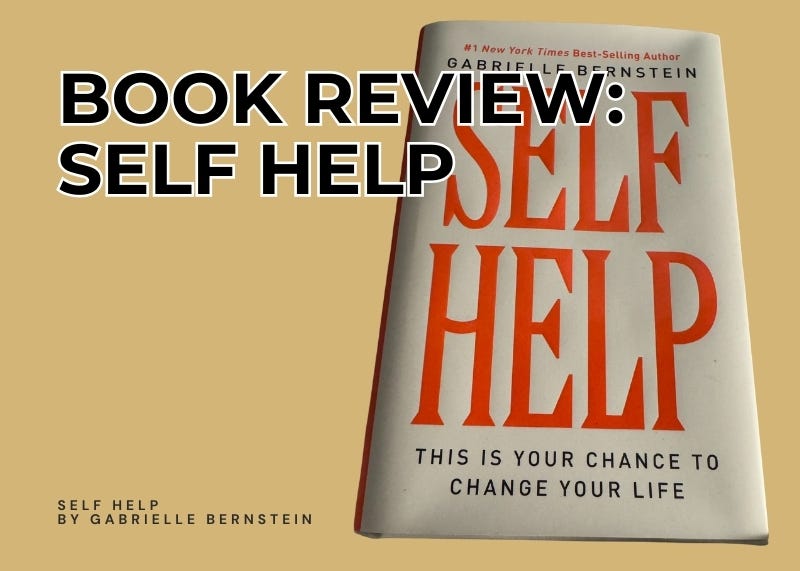
I pre-ordered Gabby’s latest book “Self Help: This Is Your Chance To Change Your Life” and received bonus meditations and lectures. Gabby often gives extra value to those who pre-order her books.
Pre-ordering books from authors helps them tremendously to gain higher rankings early on, which means more visibility (placement and promotions), which means more sales. I love to support good authors in this way especially if I’m going to buy their book anyway. Then it’s a nice little surprise in the mail six months later.
Self Help is a guide based on a therapy model called “Internal Family Systems” also known as IFS. Gabby shares both what IFS entails as a therapy models and her personal experiences with utilizing this therapy model leading the reader through a 4-step check in method. This method guides the reader with key questions to ultimately de-escalate those parts of us who would keep us safe with counterproductive or even destructive behaviors by implementing curiosity and compassion.
The chapters go through IFS methodology, mindset, her personal experiences and how our protector parts can show up. Gabby not only offers up the basic 4-step check in method, but also additional questions, prayers and meditations to help reframe your mental and emotional state.
One of my favorite quotes from the book:
We cannot heal what we cannot see, and we cannot transform what we won’t accept.
What is IFS?
IFS is an evidence-based psychotherapy that views the mind as a system of parts or subpersonalities. This therapy model was developed by Dr. Richard Schwartz; also known as Dick Schwartz.
It’s like the cliche scene of a person in a therapists office laying on the retro therapy couch while the therapist asks a series of questions. How does that make you feel? Does this feeling stem from your childhood?
But instead of going through this daunting scene, IFS puts the inquiry on the individual and in real time or as the experiences or feelings arise in that moment.
There are two main categories of protector parts. There are managers and firefighters. Both are trying to protect you based on something you’ve gone through in the past whether it’s big T or little t trauma. They are trying to protect the traumatized parts of you referred to as the “exiles.”
The managers are protective parts that show up regularly for everyday life. It’s the day to day control. The managers can quite literally show up as micromanaging, a workaholism, emotional suppression,
The firefighters are the more extreme protectors that will show up when the manager coping mechanisms no longer work. These can show up through drug addiction, alcoholism, bulimia, self-harm, etc. The firefighters are trying to numb or escape unbearable feelings through these drastic behaviors.
Professional Support
I also see a therapist regularly and informed my therapist I was reading this book and may bring up my lessons or journal entries in our sessions. While my therapist isn’t an IFS specialist, they were generally familiar with the model. Having my therapists added guidance allowed me to do extra processing. This assistance allowed me to safely work through a couple of my “firefighter” parts. Knowing that I had extra support lessened the fear of working through these more triggering parts of my Self.
I recommend incorporating the “Self Help” IFS work with a therapist. Gabby recommends it and/or working with an IFS-trained therapist. Otherwise, Gabby recommends to just work with your “manager” parts through this book for now. Our “firefighter” parts can bring up lots of trauma and trauma responses that require extra support.
Parts I got to work with
I got to work with both manger and firefighter protectors.
Perfectionist who didn’t believe in herself
One of my manager protectors is who I liked to call “The Perfectionist.”
However, this perfectionist doesn’t come from someone who is just a “control freak.” Oh no no no… This perfectionist is a sabotager.
Driven by crippling perfectionism, I halt progress with endless prerequisites. It means taking every industry course, manually researching and comparing every possible vendor, and refusing automation because everything must be done my way. This obsession with total control and becoming the expert in every single facet ultimately drains my creative bank, leaving me with nothing when it’s finally time to create.
Every single step of the way, I get harder on my self and more overwhelmed.
I don’t deal well with overwhelm so I’ll shut down, procrastinate, and eventually just give up.
My perfectionist says, “If it’s not perfect and I’m not a master at every aspect that the project requires, it’s not good enough to continue on whether I’ve launched or not. I’m not good enough to continue on. I don’t have what it takes.”
This stems from my teenage years when close family members constantly implied I wasn’t good enough—I was either doing too little or too much. When I shared my dream of pursuing a top, faraway university, their only support was presenting fear, focusing on cost and impossibility. Even when I offered solutions like scholarships and grants, I was told my grades probably wouldn’t make the cut anyway. That lack of belief and constant discouraging feedback evolved into a negative motivating operation. Now, that same rejection has manifested as an overwhelmed perfectionist who self-sabotages any big goal, secretly believing I’m still not good enough.
Through the IFS work I was able to show this disheartened teenager part the compassion she deserved. She now knows that the projections and external validations (or invalidations) of others hold no weight. What’s more is I now know the signs that she’s peaking her head out trying to protect me and I can put her at anxious overwhelmed heart at ease. Read the in-depth reflection HERE.
Warrior in Survival Mode
There’s a destructive fiery part of me. She’s the warrior. She attacks without regard for the permanent damage. She hits below the belt. She takes the best part of her — the empath — and weaponizes to precisely strike weak spots. Insecure spots.
This survival mode part is the overcompensating warrior.
The overcompensating warrior is a fire fighter part. It goes to extremes. The problem is she doesn’t care who the true target is. If this warrior catches you in her cross hairs or perceives you to be the actual threat, oh boy, just walk away.
This overcompensating warrior reared her ugly head when she was about 16yo. The compounded pressure cracked her perfect daughter persona. The beast was unleashed. Unhinged. All the things she wished she could say came out a thousand times worse dressed in poisonous spikes for words.
This overcompensating warrior wished she could have defended herself when she was younger and had less power. She wished she could have defended her mom and siblings more when she was younger, but needed to walk a fine line. Once she realized the line was gone, the straight and narrow didn’t matter anymore.
This firefighter part overprotects when survival mode is activated. When things seem to be a threat to her character or basic needs; or when she’s faced with gaslighting, this warrior mode activates like a spontaneous volcanic eruption.
Working with my therapist on this extreme part has been key. Therapy has gotten me to keep this part at bay. I’ve been able to see the signs of this part and take a pause when I notice it arising. Therapy has given me tools to detour from this mode — to choose different energy and reactions.
The IFS methods in the Self Help book has guided me to see this warrior in a different light. I may see her pain with clarity and her protectiveness with compassion.
Bonus Material from Gabby
Gabby loves to throw in bonus material and content to support her readers. In the beginning of the “Self Help” book, right after the table of contents, there is a QR code and website URL for addition resources. To remind the reader, she mentions this URL throughout the book.
These resources include audio recordings of guided check-ins for specific chapters, a directory for IFS therapists, a relevant podcast, and a detailed IFS blog. In addition, Gabby offers a 7-day free trial to her mobile app where the reader can unlock a full “Self Help” audio course along with all the fabulous features her app has to offer. That offer can be found on this resource page as well.
How the “Self Help” Book Has Affected My Life
I highly recommend this book for anyone who’s feeling stuck in their life, habits or behaviors and is willing to make a change. These methods have helped me get out of mental loops with false beliefs based on self doubt and also general anger & distrust toward men.
I utilized all the tools from the additional resources website, my journal, confiding in my spouse & close friends, the Gabby app and additional processing with a licensed therapist. Not everyone has access to all of these resources, but I bet you have access to at least the first 2 or 3.
Make no mistake, this work is scary because our parts are trying to keep us safe from both real and perceived threats. This work is not easy and will take practice.
It’s okay if you’re not ready to open this book yet. You will when you are ready. If you’ve made it to the end of this post, however, something tells me you might just be ready to meet with your parts and embark on this healing journey.
If you do read “Self Help,” I would love to hear your experience with it. Reply to this email, comment on this post, or send a message in the “Aligning Mom” chat on the Substack app.